 Jubilee Post News & Views
 Dr. Utkarsh Sinha
The recent violence in Bangladesh has clearly shown that after the political turmoil and regime change of 2024, radical forces within the country’s power structure are not only reorganising but have also reached a position where they can openly implement their agenda on the streets. The way the mob, enraged after the death of student‑youth leader Sharif Usman Hadi, targeted media houses, cultural institutions and pro‑India symbols indicates that this is not just an emotional outburst but a well‑organised political‑religious project. The question now is not only how soon Bangladesh will recover from the violence, but in which direction the country is being pushed – towards an inclusive democracy or towards a “hybrid Islamic republic” where real power lies in the hands of radical forces and the military‑intelligence nexus.
The fire that began with Hadi’s death
Sharif Usman Hadi had emerged as a key face of the student‑youth movement of 2024, and the news that he succumbed to bullet injuries inflicted by security forces in hospital shook the entire country. His death reignited the anger of a generation already battered by unemployment, inflation and political instability, but the direction in which the mob on the streets was steered does not appear to be accidental.
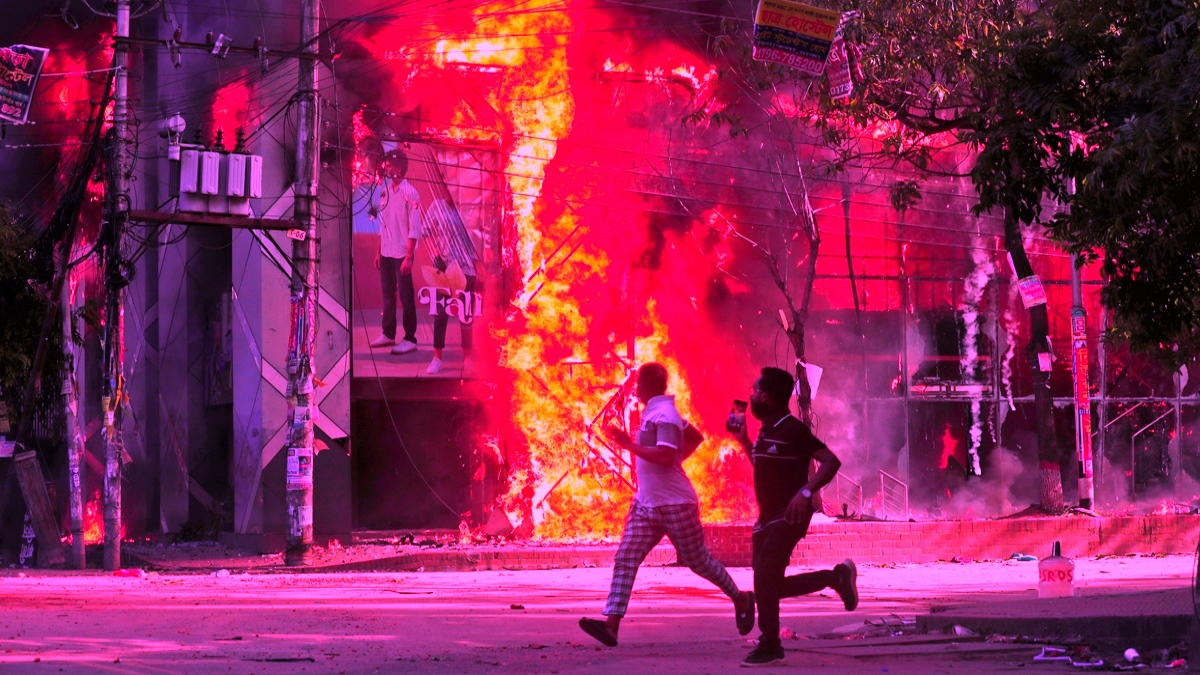
The first victim of the violence was not the state but the media – attacks, arson and vandalism at the offices of major newspapers like Prothom Alo and The Daily Star show that the real target was that ideology which has tried to preserve a secular‑liberal democratic narrative within Bangladesh. In this mob, the active presence of groups long associated with Jamaat‑e‑Islami and other radical organisations was recorded, which clearly suggests that the real direction of the anger was fixed from there.
Power structure after the coup and the return of radicalism
The interim arrangement formed after Sheikh Hasina’s resignation was initially seen as an opportunity to move towards “democratic transition”, but gradually it became clear that those who controlled the power of the streets were also being given a share in the power structure. The set‑up led by Dr Muhammad Yunus has continuously faced allegations that, in the name of “stability”, it granted legitimate political space to Jamaat‑centric and radical Islamist groups so that they would not launch an open armed rebellion against the state.
That very space is now returning in the form of violence. Jamaat‑e‑Islami and its student/youth wings – which have been accused of everything from carrying the legacy of 1971 war crimes to running terror networks – are now not only managing the crowds on the streets but are also in a position to bargain with the state. This model is reminiscent of Pakistan in the 1980s and 1990s, where the attempt to run “jihad” and “democracy” side by side ultimately pushed the entire society towards extreme violence and instability.
ISI and the new ‘Dhaka Cell’
It would be a mistake to view the resurgence of radical politics in Bangladesh separately from Pakistan’s ISI and its new strategy on the eastern front. According to several reports, a special “Dhaka Cell” is active within the Pakistan High Commission in Dhaka, in which military‑intelligence officers are posted; its declared objective may be diplomatic and security cooperation, but its real agenda is believed to be strengthening anti‑India and Islamist networks.
The role of this cell is described at three levels – contact and “coordination” with the top leadership of Jamaat‑e‑Islami, ICS and other Islamist organisations; think‑tank‑level engineering of social‑media, digital propaganda and anti‑India narratives; and, in some border and urban areas, building “proxy networks” through funding, training and logistic support.
There is also information that prominent Jamaat leaders have held several meetings with the Pakistan High Commission in recent months, which, for the first time since 1971, indicates such an open political proximity at this level. This is the very period when anti‑India slogans, demonstrations outside Indian missions in Bangladesh and orchestrated propaganda on social media were seen surging simultaneously.
External agencies and the politics of ‘managed crisis’
Pakistan is not alone in this. Over the last one or two years, global and regional agencies keeping a watch on Bangladesh’s political transition have had their own interests, which can be understood in the broader context of “regime change” and “India‑balancing” strategies. For China, this is an opportunity to draw such a neighbour more tightly into its economic‑strategic embrace – a country that is, on one side, a gateway to the Indian Ocean and, on the other, has the potential to exert pressure on India’s eastern flank.
The assessment of the Indian security establishment is that turning Bangladesh into a “low‑intensity crisis zone” can be useful for both Pakistan and China, because it would tie up a large share of India’s political and military energy in its eastern border and the security of the northeastern states. At the same time, by fuelling anti‑India sentiments within Bangladesh they can not only weaken the trust between Delhi and Dhaka but also block any possibility of a revival of South Asian regional cooperation (SAARC/BBIN).
Hindu minorities and media: easy targets
In the latest wave of violence two symbols have been particularly targeted – the media and minorities. Attacks on media houses send out the message that the battle for control over the “narrative” is now being fought openly on the streets; any newspaper or channel that criticises radicalism will be branded “pro‑India” or “anti‑Islam” and punished.
For minority communities, this violence adds yet another terrifying layer. In the past one or two years, a large number of small and big attacks on Hindu, Buddhist, Christian and Ahmadiya communities, vandalism at temples and forcible displacement incidents have been recorded, whose aim is to create permanent insecurity at a social and psychological level. In such a situation, minority families either treat silence itself as their security, or gradually look towards migration; as a result, Bangladesh’s pluralistic identity keeps getting weaker.
Ordinary people stuck between fatigue, anger and the search for alternatives
Yet it would be wrong to assume that the whole of Bangladesh is moving towards radicalism. In Dhaka, Chittagong and other cities, large numbers of students, middle‑class citizens, journalists and civil society activists are openly condemning this violence; the Editors’ Council, Press Club, NOAB and other organisations have called it an attack on democracy and freedom of expression.
But the biggest challenge before this resistance is the “fatigue” of the people. Continuous political crises, economic difficulties and unemployment have made such a large section of the population so disillusioned that they are leaning towards the mindset of “whoever gives us some stability is acceptable”. Radical forces are finding space in precisely this exhausted society by promising “law and order” and “Islamic justice”, whereas, on the other hand, democratic forces have so far been unable to present a compelling and concrete alternative.
A message for India: the fire across the border
The upheaval in Bangladesh is not just a diplomatic or humanitarian concern for India but also a concrete security challenge. During the violence, demonstrations against the Indian High Commission and consular premises, anti‑India slogans and social‑media troll campaigns have made it clear that projecting India as an “enemy” is an integral part of this new narrative.
If Jamaat‑centric, Pakistan‑backed and military‑intelligence alliances put down deeper roots in Bangladesh, its direct impact will be felt on the security of Assam, Tripura, Meghalaya and West Bengal, on cross‑border smuggling, on radical modules and on refugee crises. For India, this is a time to do two things simultaneously – on one side, to strengthen its image within Bangladeshi society through people‑centric, development‑oriented and respectful diplomacy; and, on the other, to adopt a tough intelligence and security strategy against ISI‑supported networks, online propaganda and cross‑border terror‑criminal nexuses.
Bangladesh at the crossroads
Today Bangladesh stands at a juncture from where only two paths are visible. One, that the compromise between the power structure and radicalism deepens, and the country moves towards such a hybrid model where elections do take place but the real agenda is set by Jamaat, ISI and the military‑intelligence nexus. The other, that a new alliance of Bangladeshi civil society, student movements, the media and progressive political forces emerges, which brings the legacy of the 1971 Liberation War back to the centre and challenges the radical project.
The blood flowing on the streets of Dhaka and the burning newspaper offices are not merely an internal problem of one country; they are warning the whole of South Asia that if democratic institutions, civil society and neighbouring countries do not find ways of positive intervention in time, radicalism and external interference together can push the entire region into a prolonged phase of instability. The question is not whether Bangladesh will change or not; the question is whose grip will shape that change – that of the people, or of those forces that are writing the future in closed rooms and in the shadows of foreign embassies.
(Author is a Senior Journalist)